
Choosing the Right Box Size for Your Wedding Dress.
What's the right box-size for your wedding dress?
There’s a question almost no one asks before putting their dress away — and it should be the first one: “What size box do I actually need?”
The answer seems obvious at first: “whichever box the dress fits into.” But the truth demands more precision than that. A box that’s too small compresses the fabric beyond what it can bear; one that’s too large leaves the dress adrift inside, without the support it needs. Either way, the result is the same — creases that become permanent, damaged fabric and embroidery, and years of careful conservation undone by a detail that seemed too small to matter.
Why Box Size Isn’t a Small Detail
Think of the box as a second structure for the dress — almost a mold that will hold its shape for decades to come. Get that wrong, and every other conservation measure — acid-free materials, neutral tissue paper, a dark, dry environment — loses some of its effect.
A box that’s too small:
-
- Forces tight, excessive folding just to make the dress fit.
- Compresses lace, embroidery, and pearls, risking deformation or breakage.
- Creates constant pressure points that deepen into permanent creases over time.
A box that’s too large:
-
- Leaves the dress without lateral support, letting it shift and bunch to one side.
- Requires extra, looser folds to fill the empty space — which also creates creases.
- Undermines some of the box’s protection, since parts of the fabric stay exposed to movement whenever the box is moved.
The goal is always the same: a fit that’s generous but precise — enough room for the dress to breathe and settle into a few broad folds, without so much empty space that it becomes unstable.
The Factor That Matters Most: Volume, Not Just Length
It’s tempting to assume length — the dress or the train — is the deciding factor. In practice, though, what determines the right box size is volume: how much fabric, interfacing, and layering the dress actually holds.
Two dresses of identical length can need entirely different boxes:
-
- A mermaid gown, fitted to the body, carries relatively little volume — even with a long train, it folds compactly.
- A ballgown, with a tulle skirt and multiple layers of petticoat, can hold twice the physical volume of a mermaid gown of the same length — and needs far more vertical space so it isn’t crushed.
Choosing the right box, then, isn’t only about measuring the dress top to bottom — it’s about understanding the silhouette and the sheer amount of fabric involved.
Three Silhouettes, Three Different Solutions
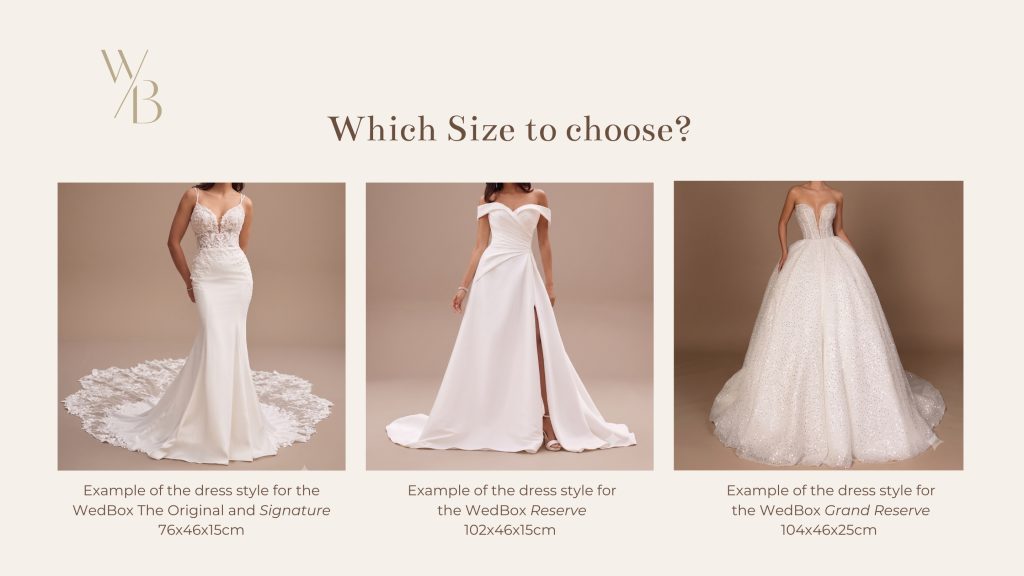
To make this concrete, here are three of the most common dress profiles — and the box that best suits each one:
| Silhouette | Characteristics | Recommended Box | Dimensions |
|---|---|---|---|
| Mermaid — fitted to the body from bust to knee (or just above), flaring out below to define the silhouette. | Low volume, fabric fitted closely to the body | WedBox The Original or WedBox Signature | 76 × 46 × 15 cm |
| A-Line — fitted at the waist, flowing gently to the hem in an “A” shape. | Moderate volume, longer train length | WedBox Reserve | 102 × 46 × 15 cm |
| Ballgown — fitted bodice with a voluminous skirt, creating the classic fairy-tale silhouette. | High volume, needs greater depth for storage | WedBox Grand Reserve | 104 × 46 × 25 cm |
Notice the pattern: between the Original/Signature and the Reserve, what changes is mainly length (from 76 to 102 cm) — because the train is longer, while the fabric itself stays relatively thin and compact once folded. The Grand Reserve, by contrast, keeps a similar length to the Reserve but nearly doubles the height (from 15 to 25 cm) — because that’s what a multi-layered dress truly needs: vertical space so its volume is never compressed.
How to Know Which Box Is Right for Your Dress
If you’re unsure which option to choose, these questions can help:
-
- Is the skirt close-fitting, or does it have visible volume? If you can wrap your arms around the skirt with little resistance, you’re likely looking at a lower-volume dress. If the skirt holds its shape firmly even with no one inside it, that’s a sign of higher volume — and that you’ll need more vertical space.
- How many layers does the skirt have? A simple lining is very different from several layers of tulle or a structured petticoat. More layers mean the box needs more depth.
- What’s the total length, including the train? This is the factor that most influences the box’s length — not its height.
- Does the dress have embroidery, pearls, or raised appliqués? These details are especially sensitive to pressure and always benefit from a little extra room rather than the tightest possible fit.
And if you’re still torn between two sizes, always size up. A little extra space, filled with neutral tissue paper, is always preferable to a dress compressed beyond reason — excess space is easy to correct with a few more rolls of tissue paper; excess compression isn’t.
Still Not Sure? Talk to Us
We know this isn’t always easy to judge alone, especially without two options side by side. That’s why every WedBox order comes with personal guidance: tell us about your dress — silhouette, fabric, train length — and we’ll help you choose the size that will truly preserve every detail of it, today and for decades to come.